Create a family drop zone that fits a narrow entryway
· Editorial team newswithmiadenver.com
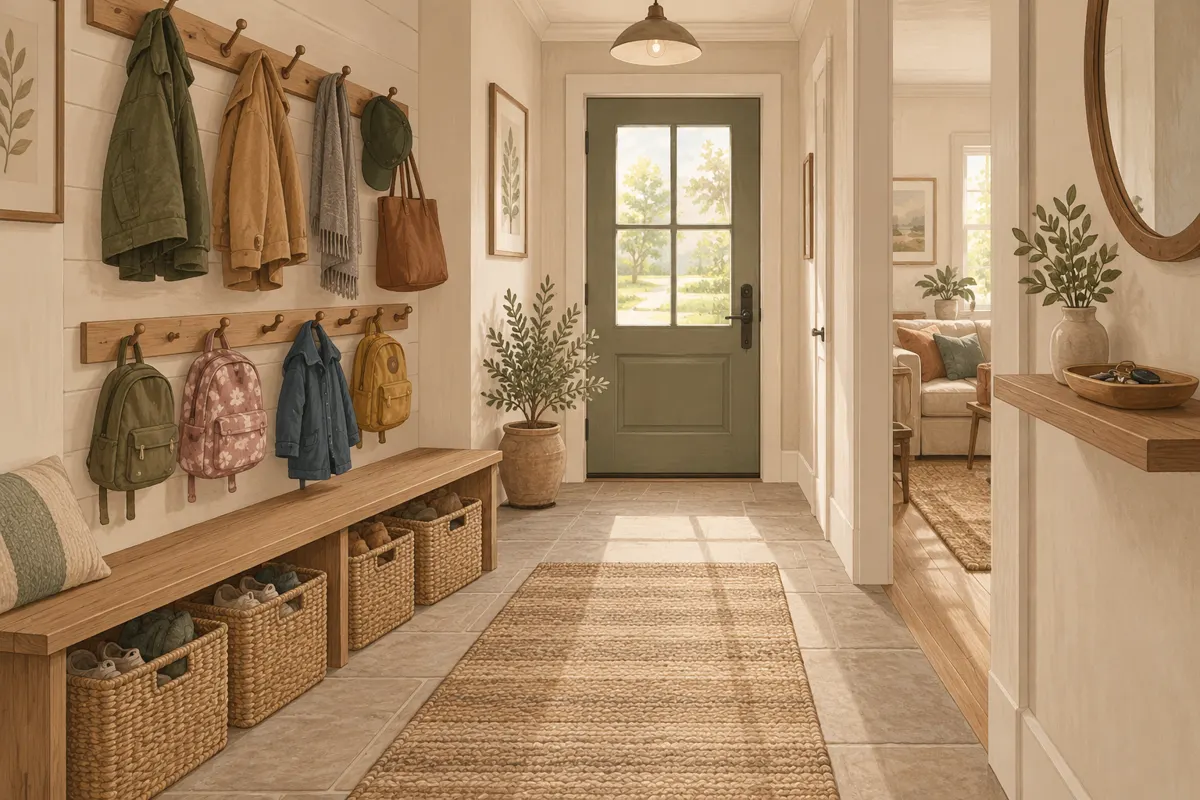
Create a compact family drop zone by using one wall for reachable hooks, giving each person an open basket and keeping shared car keys in one fixed spot. Store only everyday essentials near the door, and leave the walking route clear. The proposed setup below pairs those storage ideas with a five-minute evening reset to prepare for the next morning.
Start with the space people need to walk
Empty the entryway before choosing storage. Move off-season coats, spare shoes and occasional sports equipment elsewhere. Then identify what your household actually brings through this door: school bags, everyday jackets, shoes, keys and perhaps a few papers. Those items should determine the setup.
Measure the available wall and floor space with the door fully open. Account for closet doors, drawers and the depth of a hanging backpack. A shallow shelf may fit where a console would crowd the passage, while a bench makes sense only if someone can sit without blocking others.
- Open the front door and any nearby closet doors fully.
- Walk through carrying the bag you normally use.
- Check that baskets stay within the storage area.
- Keep access to door handles and switches clear.
Place hooks where each person can reach them
Hooks offer a simple place to hang jackets and bags when hands are full. Put children's hooks at a height they can reach independently, with adult hooks higher or alongside them. Before fixing the positions, have each person try hanging their own jacket and bag.
Our proposed starting point is a jacket hook and a bag hook for each person, space permitting. Leave enough separation that a loaded school bag does not cover the neighboring hook. Follow the hardware's mounting instructions and weight limits, particularly for heavy backpacks.
Keep the jacket currently in use here and move spare coats to a closet. If bags project too far into the hallway, place their hooks inside an adjacent closet or on another suitable wall. Give bulky activity equipment a separate home rather than trying to fit everything beside the front door.
Give everyone one easy-to-use basket
Assign each family member an open basket for everyday shoes or small loose belongings. Individual baskets make ownership clear, and an open top removes the extra step of lifting a lid. Place them beneath a slim bench, on a low shelf or inside a nearby closet, wherever they fit without narrowing the walking route.
Choose the basket's job before filling it. In our proposed setup, shoe baskets hold only the footwear being used regularly; gloves and hats go in a separate reachable pocket or drawer. If small accessories share a basket with shoes, use a removable pouch to keep them together.
- Use a name, color or simple picture to show whose basket is whose.
- Choose a size that fits the available space and daily contents.
- Move surplus items elsewhere when a basket becomes difficult to use.
- Let wet or muddy footwear dry in a suitable spot before returning it.
Create a fixed spot for shared keys and papers
Use a shallow wall shelf, small drawer or secure key hook for shared car keys. Pick a position adults can reach comfortably and agree that keys return there whenever someone comes home. A small tray can also hold a wallet or sunglasses, provided it does not become a catchall.
For school forms and outgoing mail, our proposal is one slim wall pocket for papers needing attention. Once a permission slip is signed, put it directly into the correct school bag. Move records and paperwork that need longer-term storage out of the entryway so the pocket remains usable.
Use a five-minute evening reset
Try this proposed five-minute routine at a consistent point in the evening, such as after dinner. Each person handles their own belongings, with help where needed. The aim is to leave tomorrow's essentials ready and the passage clear.
- Return shoes to their baskets and hang everyday jackets.
- Empty school bags of food containers and loose papers.
- Pack the items needed for tomorrow and return bags to their hooks.
- Check the shared key spot and deal with any urgent forms.
- Carry stray belongings to their proper rooms and clear the floor.
If the same item repeatedly lands on the floor, adjust its storage spot: a hook may be hard to reach, a basket too full or a bag too bulky. Change that one obstacle first. A useful drop zone should be easy for the whole family to use on an ordinary busy day.